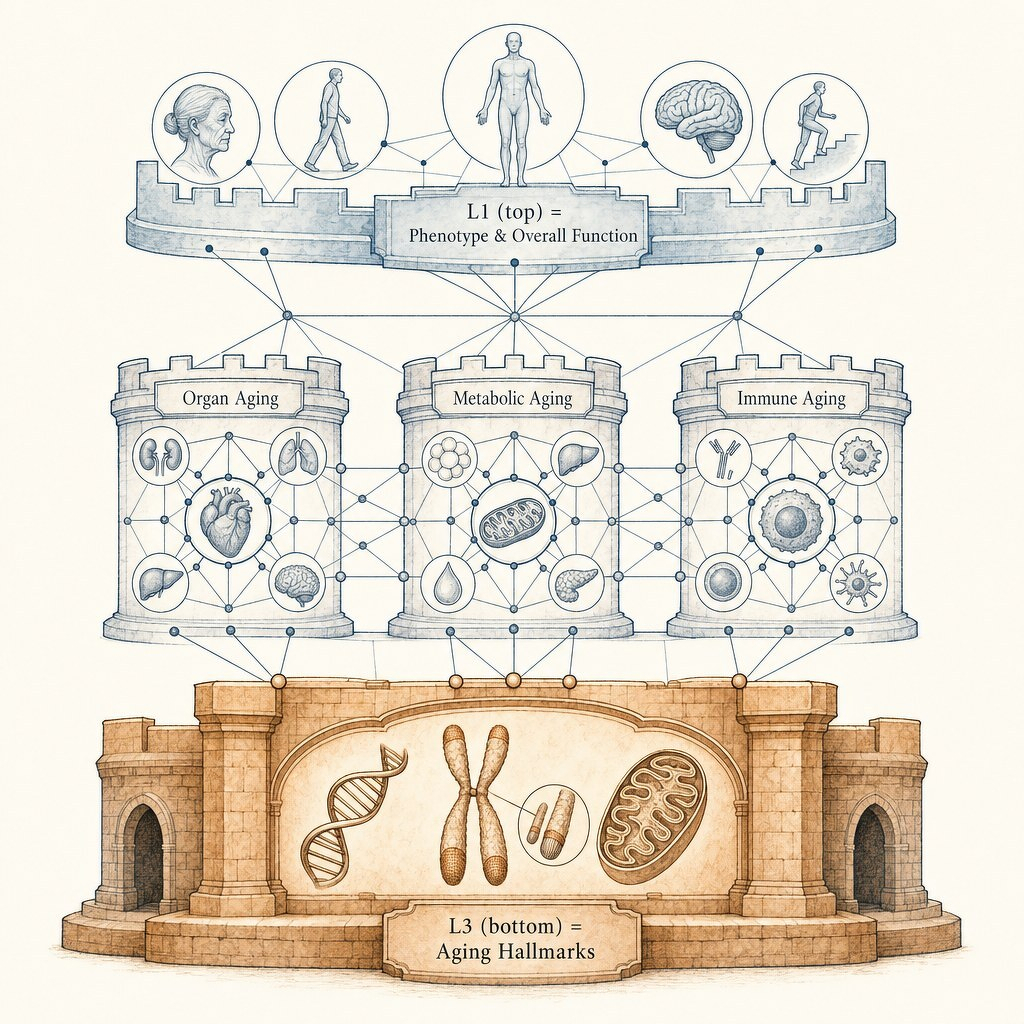
Your disease risk isn’t a number — it’s a slope. Reserves fall across five lines for years before diagnosis: phenotypic warning, organ function, metabolic stability, immune repair, hallmarks. Manage the slope, not the score.
I’m rarely on LinkedIn — email: jianghui@deepome.com
A steerable model must answer counterfactuals: what transition would this module have made without the intervention? That question separates a world model from a black box: www.preprints.org/manuscrip…
I’m rarely on LinkedIn — email: jianghui@deepome.com

Two patients, the same symptom score, different mIC states — the same intervention, different outcomes. Why N-of-1 medicine needs a state layer, not just risk scores: www.preprints.org/manuscrip… I’m rarely on LinkedIn — email: jianghui@deepome.com

mIC = module-level intrinsic capability: our proposed state format for biomedical world models. One vector per module; an intervention is defined by the transition it induces: www.preprints.org/manuscrip… I’m rarely on LinkedIn — email: jianghui@deepome.com

We want to steer a body, not just predict it — but most medical AI only forecasts. A model must clear five checkpoints to steer; miss one and it is just a predictor: www.preprints.org/manuscrip… I’m rarely on LinkedIn — email: jianghui@deepome.com

We want a map honest enough to show its own blank spots. A third of our 332 modules have no known intervention. We publish the gaps and take nominations: steeramed.com/en/bench/… I’m rarely on LinkedIn — email: jianghui@deepome.com
We believe a model that can’t say where it fails isn’t science. Ours, published first: hold out one disease, and performance drops to a coin flip — on the landing page, not in an appendix: steeramed.com/en/bench/ I’m rarely on LinkedIn — email: jianghui@deepome.com
We believe more data is not more medicine. We tested the full marker atlas against a small curated panel — the atlas won outright in only 9 of 23 diseases. Pick modules, not markers: steeramed.com/en/bench/ I’m rarely on LinkedIn — email: jianghui@deepome.com
Our one question: can human health be steered, not just predicted? Three preprints — what a steerable model must have, one person’s evidence chain, and an open benchmark with failure modes first: steeramed.com/en/bench/ I’m rarely on LinkedIn — email: jianghui@deepome.com

An AI agent proposed and refined aging modules under a frozen protocol. Of 7 concepts, 2 reach nominal significance (ECM stiffening +0.031, TRM efferocytosis +0.021); none survive FDR. Replay is public: steeramed.com/en/bench/… I’m rarely on LinkedIn — email: jianghui@deepome.com
Our claim: 332 capability modules are the right unit for steering human health. Any such claim has to lose somewhere. Next three posts: where a 117-axis panel beats the atlas, where we drop to chance, and which axes have no handle.> I’m rarely on LinkedIn — email: jianghui@deepome.com
Put a human on Mars, Europa, Kepler-22b — which capability reserves get remodeled first? A pure test of deduction: no new data, only whether the reasoning survives published biology. Which reserve would you bet breaks first? I’m rarely on LinkedIn — email: jianghui@deepome.com
Which representation ranks repurposing drugs best? It depends on the disease: Hallmarks won cancer (recall@20 0.900), food-as-medicine won depression, TCM won sedatives; the full atlas was strictly best in only 9 of 23: https://www.preprints.org/manuscript/202608.0998/v1

Everyone is building virtual cells. We’re after the missing layer between cell and patient — emergence, pathway compensation, and whether this person responds to this intervention. The figure contrasts the two: https://steeramed.com/en/

We built SteeraMed Bench to answer one question: can an AI-generated “aging module” actually predict drug effects? The setup: 332 modules × 1,916 repurposing drugs × 23 disease categories, one frozen protocol for everyone. The diagram shows the instrument: https://steeramed.com/en/bench/

Our new preprint maps human health as 332 capability modules — 117 nutrient, 105 food-medicine, 72 aging-hallmark, 38 syndrome axes. Figure 1 shows how the atlas and its frozen evaluation protocol fit together: https://www.preprints.org/manuscript/202608.0998/v1

The AI virtual cell is fashionable. But a patient is not a bigger cell — between them sit emergent transitions, pathway compensation, heterogeneity. Missing is not a larger model but another scale of map, plus action semantics and a retest loop a virtual cell doesn’t have.
Biomedical knowledge lives in three forms: travelogues (reviews), museums (databases), maps (computable knowledge). Astronomy has star catalogs, chemistry the periodic table. Biology has the largest data output in science — and still no coordinate system of its own.
Our starting axiom: a body is a set of capabilities for adapting to its environment. Not a gene list, not a network diagram. Everything downstream — capability axes, response mapping, module panels — is deduced from that one sentence, then tested.
Systems biology tells us how a living system runs. A world model tells us how it moves under an action. A steerable model asks a third question: how does the rider get there without breaking the horse? Not a rebrand — a different task.